Less (body) is more (imagination)

- Details
Shirel Horovitz
Less (body) is more (imagination)
Interview with Daniel Blanga-Gubbay
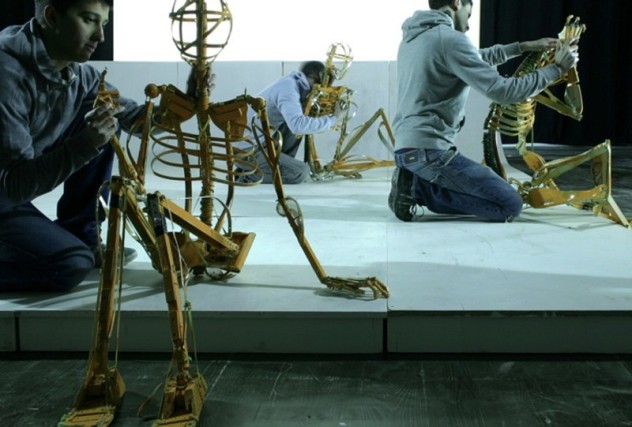
Photo: Paola Villani
Daniel Blanga-Gubbay keeps the different parts of his life somewhat separate. In a swift online search I was left with pockets of missing information between his university work, performance projects with the Pathosformel group he co-founded and his personal life. So I started this interview wondering:
what lies between these gaps and if they have anything to do with his work.
Well, there are two kinds of bios of mine: I teach at university and so that bio starts with my academic career, then there is the other type of bio that usually starts in 2004 when I created Pathosformel together with Paola Villani. I like the fact that I can create this artistic personality that isn’t fully identified with me personally.
I never reflected on this, it’s not really on purpose, but now that I think of it [he says with half a smile], my facebook is hidden so it’s not so easy to find me. I think I’m actually quite happy about these hidden parts of information.
I always kept my theoretical work independent; most of my students don’t know that I also do performing art. For me the two are clearly connected and aren’t possible with out each other, but I don’t want my students to think that what we’re studying is connected in a way to what I’m doing in performing art. I want to keep its autonomy, to keep them separate.
Born in Milan in 1982, Daniel studied his BA there and moved to Venice to study performing arts and philosophy. After graduating from the University of Architecture in Venice, and having founded the performing art project Pathosformel together with Paola Villani, in 2008 he began a European Ph.D. in Cultural Studies, publishing a thesis on gesture as the relationship between body movement and expression of possible. He currently lives between Brussels and Düsseldorf, where since 2012 he has a position as a researcher at the Heinrich Heine Universität, working on political philosophy for the arts.
These separations and gaps that exist in your online personality appear in various ways in your performances.
Precisely, this is very important for me in terms of the relation with the spectators. It’s always about creating a structure of silence. Leaving something open, not for the subtraction itself but to keep some open space for their imagination. The ability of the spectator to create his own story or narrative is very precious.
Do you think the fact that you didn’t originally come from the performing arts had an influence on this search for the open spaces?
Yes. It’s the possibility of creating something new from imagination and not from knowledge. Paola and I met at the university in Venice and we wanted to do something together, I mean Venice is a very boring city as well so you need to engage yourself in projects outside of the university. We didn’t come from a theater or performing art background, Paola came from design and I from art theory and neither of us ever acted. So we started with the idea of creating performance but focusing more on non text based performances. At the same time I was working on my thesis about the relation between images and materiality in the work of art and this too was connected to the beginning of our process.
Viewing your work I found myself thinking of Malevich’s white on white as well as John Cage’s 4:33. Both of them hold the silence and space for imagination. Can you give a few examples of where you draw your inspiration from?
You mention these works and it’s true that most of my inspiration doesn’t come from performing arts but rather from fine arts. Malevich was indeed a point of inspiration and especially his white on white. I was very fascinated by the fact that behind this painting there were figurative compositions. With this he was saying that every revealed composition is a death to the work of art because then it no longer has open possibilities, it is no longer endless. It’s a way of giving less that is actually giving something more. This is one of the basic and central questions I ask - how can you give less in theater. For example how can you put into question one of the core elements - the presence of the human body which we often consider as the starting point of performing arts. In “The timidity of bones”, our work from 2007 we’re giving less but the spectator is constructing the body, we’re creating this Malevich like open space.
In “The timidity of bones” the white on white inspiration is clearly apparent.
A white framed cloth divides the space between the body on stage and the spectators. The fragments appear singly as the body from the other side of the screen pushes into it, gradually reconstructing the familiar image of a human body. Femur, knuckles and shoulder blades are broken and exposed through the thin, skin like cloth so that they can no longer conceal anything, favoring the appearances of the bone over the shape of the flesh. This exposure changes the perception of the body and creates a sort of dance, resembling the way a fetus’s anatomy is defined to our outside gaze by pressing against the walls of a pale womb. In a slow progression the body is separated from matter, and embarks on a struggle against the cloth, in a perpetual unsuccessful attempt to establish its image.
You put great emphasis on the active role of the viewers, what kind of reactions do you get to your different works?
The differences in reaction were most apparent when performing in front of different age groups. With children the most interesting one was with “The timidity of bones”. Children are completely open to imagination. They don’t care about the fact they should be silent. So every time something would appear on the screen they were doing what adults do, trying to figure out what part of the body the body they are seeing but they were just shouting it. It was very nice because they started the discussion of what kind of body it is, during the performance , how can you imagine this body by the different parts of it that appear.
In “The first suburb” (2010) three performers and three monochrome bodies, deprived of any character or facial expression are on stage. The three anatomical models abandon themselves to be modeled from the outside by the performers. The work examines the astonishing physical actions and methods of operation of individual mannequins. Every movement, every gesture, even the minor ones, requires the operators to a series of actions and complex movements that in turn mimic the human body. Quietly and accurately in a virtuosic concentration, these abstract actions on stage lead to the depth of meaning and thought underlying the human action.
In “The first suburb” you also reconstruct and deconstruct the body and its movement but in a very different way. On the one hand you’re subtracting from the body but on the other you are actually creating the attention through exposing more than we usually notice.
Yes, in this work we reconstructed the movement of the body on another body and it was very interesting. The construction itself was a long process, as we were moving these machines we understood some parts were not correct and changed them. It was fascinating just discovering what this thing we call human anatomy is. We learned a lot as we were building them. Looking at basic daily gestures such as the way we walk, deconstructing them to understand how to recreate them.
In “The first Suburb” we are three people on stage – me, performing for the first time, and two other guys. One very young, he was eighteen and with no experience when we started this work and the other, the third was a theater technician. We started working with him to build the body and then we asked him to join us and perform as well. After a little resistance he agreed. So he too had no performing experience. We conceived the idea of building the bodies and moving them as a whole process.
In this way the choice of performers, having the technician on stage, also blurs the lines between what lies behind the scenes and what is visible to the spectators.
I think part of this also comes from the fact that we didn’t want to have choreography but rather to give life to something you technically know very well but usually don’t consider with so much attention.
In this performance the age also created very interesting reactions. It was a very strong experience for old people. It was very interesting; they were completely into it and in love with this work, projecting on it something of their own life.
It might be because of the heightened awareness to the body that is no longer able to move itself in the way they were used to use to.
We take the movement and gestures that we do all the time for granted and in this performance it becomes very apparent how much energy it consumes. Technology is constantly trying to imitate the human body and mind. There is quite a lot written about the absence of technology in “The first Suburb” as well as in many other works you created, was this relation to technology part of the initial idea or a kind of byproduct?
Well, the idea at the core of the work was what you mentioned first, bringing attention to the amount of work and energy invested in our daily gestures and how this can be transformed in a show. It’s purely magical in a way, how the bunch of possibilities of human expression, of gestures are just a matter of inclination of the human body and how by reconstructing it very precisely you can raise a huge question about the human being, about how this body is feeling in a way. At the same time I was involved in my thesis on the topic of what gesture means and so constructing gestures from the outside was very interesting for me. So it wasn’t at first about technology even though this is something that was related to us through out the process.
In a time when technology is developing so fast and you can not compete with it in a way, it was interesting to go back to the materiality of the image itself.
How can you construct something that you can hardly believe or how can you put into question something you’re not even sure if it’s happening or not, without technology. How can you challenge the certainty of the viewer without special affects? In a way it’s very simple but very important as well. We usually give a deep part of our need of fascination to special affects.
What is the starting point of your working process?
It usually starts from an idea. I like the idea of limits during creation. Just conceiving a set of limits and exploring all possibilities of expression with in them. Once we start the practical work with the screen, the squares or machines it's about sticking to the limits they create in terms of expression.
It’s something you can notice in all of our works but is maybe the strongest in “The skinny distance".
A first square joins the scene, sliding on a system of eight parallel cables, followed by the live sound of a fan harmonium and a violin. In “The skinny distance” the space fills with colored squares, which seem to graze one against the other as walking men in a crowded public square. As in a magical tale, bodies have been transformed in anonymous shapes, waiting to be reconstructed by the spectator’s eye as human presences.
Every level of these eight wires has a different note and sound that create a melody. In this work too, the technical aspects correspond to the search of the place of the human body. The movement on stage is created by hand by two people behind the scenes.
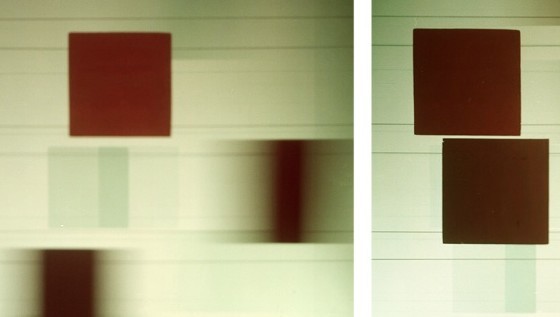
Photo: Antonio Ottomanelli
This work started from what could be a very common experience. When you go up a tower and you look at the public space from above, you can‘t recognize the people, you can’t see their faces, or their gestures. Still, it’s fascinating, because even though you can’t recognize stories, you can create them based on what you see. If you see two people slowing down after crossing each other you can invent your own narrative.
The initial question was how to reconstruct a body with completely removing the body itself, going in a completely opposite direction. That was the starting point of the performance. Then we wanted to capture the music, the sound of this type of movement so we added layers to it so it became lines and squares moving on them with live music.
Another artist that is important to me, and that is closely related to this work is Mark Rothko. I just read a text he wrote. He wanted to be a theater maker and didn’t succeed and turned to painting. But the way he works is for me pure theater because I approach theater in that way trying to remove completely or overstep the aspect of the human body and go directly to create emotion.
When I look at his paintings it makes me fully aware of my own sight and body. In your works you create this awareness too by taking away the knowledge of who the performer is and in some cases removing the body completely. Did you notice you don’t say performers or dancers when you speak about your works but rather speak of “The body” or “The machine”?
Absolutely, the people on stage are not performers or dancers. We are looking to remove the body. For example, in “The skinny distance” there are no performers at all. The stage is devoid of the human body.
Usually with this performance we get a lot of comments from people. Sometimes people say “I saw squares” which is a possibility but sometimes people come crying and say they saw part of their life, because you can project a lot on this.
I don’t find it interesting to bring people to completely believe something, I want to leave them on the edge where they don’t have to believe but they are free to imagine.
Once an old woman came to me and said “I was really moved by the story that was happening and I started to cry and then, I was moved by the fact that I was moved by squares and I started crying because of this.” I found that not only beautiful but also very interesting because she was into it but she also realized that she wasn’t forced to believe in this but rather she was the one creating her own story from geometry. This is the idea of the edge between believing there is a body there and knowing that it is a machine of nothing and that’s why we wanted the performer not to be so visible. Time and time again you know it’s reconstructed but you still have the possibility to have an emotional reaction to it as well. I think this is true also on a much broader level; an old performance lives just in the sum of memories in the head of different spectators. Based on this thought and wanting to look at the subjectivity of documentation in performing art, there is a project we have in collaboration with “Work of others”. Work of others - http://workofothers.tumblr.com
We asked people to describe shows as they remember them, as if they have to tell what was happening there to someone that didn't see the show.
What are you working on these days?
In general, right now I’m more in the theoretical perspective. Not just on my work in the university but I also started collaborating with different cultural institutions and festivals to imagine which kind of roles theory might have in these cultural events. I opened in Brussels a think tank working on political philosophy for cultural institutions so most of my energy is currently directed to that project. [ALEPPO: A Laboratory of Experiments in Performance and Politics www.aleppo.eu
By the end of this interview, it became clear to me why Daniel is so fond of the unintentional gaps in his online persona.
In a time when knowledge and automated actions are at the center of our attention, Daniel Balanga-Gubbai carefully constructs the in-between spaces and brings them to the front stage, demanding and calling on us, the spectators, to re-notice and re-use our most basic human attributes of imagination, curiosity and personal interaction.
* More works and information about Pathosformel can be found here:
http://www.centralefies.it/factory/pathosformel_16.html
Shirel Horovitz, an interdisciplinary artist, earned her BFA from Bezalel Academy of Art and Design and MA from the interdisciplinary art program at Tel Aviv university. In the last two years she initiates collaborations with artists from a variety of disciplines resulting in installations and performances, such as in her performance series Art on the go.
http://shirelshayah.wix.com/shirelhorovitz