The power of the spectator

- Details
Lior Avizoor
The power of the spectator
The Theatre as a gazing arena
When we speak of performance today, there are dozens of definition that can suit our intentions. In this particular essay, I will refer to performance genres that emerged from classical theatre, and assume the necessity of spectators. The meaning of the Greek word "theatre" (θέατρον) is ‘the place of seeing’. The theatre assumes that there is someone being seen, and someone watching.
Who watches? An audience made of thousands or just one; what do they see? Classical plays or contemporary performance. Where do they watch it? In a standard proscenium theatre designed for passive viewing, or in alternative spaces that force the viewer to move around, respond, and sometimes even take an active part in the show.
Be it puppetry, contemporary dance or cabaret, the basic ground rule for a theatrical performance (and true to all performing arts genres) - is someone watching, and someone being watched.
Here are some of the most famous definitions: Eric Bentley describes a theatrical moment as one that can be broken down into three ingredients: “A is performing B, while C is watching it”;1Peter Brook suggests a reductive definition that takes out the element of representation: “a person crosses a empty space while another is watching it, that’s all it takes for a theatrical moment to occur”. Richard Schechner takes into consideration the audience’s gaze when he describes performance as “showing doing”. Willmar Sauter places its uniqueness at the crossing point between the performer’s action (all the stage actions) and the audience’ perception of it.
In all these definitions, the viewing person is crucial to the existence of the theatrical moment inasmuch as the performer himself is needed. Throughout history and especially since the avant-garde movement of the early 20th century, many attempts were made to challenge the necessity of the audience’s gaze. It seems that even if it’s taken away or hidden, the gaze re-penetrates via various “cracks” (such as the need to document, the demand to see, and the discourse around the gaze), and thus we return to the same definitions.
It’s interesting to ponder over this dependency, through reading Jean Paul Sartre’s Philosophy of The Gaze.
In his writings, and especially in his discourse of the gaze in the book Being and Nothingness, Sartre re-places the individual’s gaze by removing it from the individuals' consciousness, and placing it in an interpersonal space. The individual, in his opinion, is constructed by the other’s gaze.
How does it happen? Sartre examines in what way the ‘other’ is played out in our lives. According to him, the relationship between the others and ourselves deviates from the simple model of sheer recognition and sensorial perception. We perceive the presence of the other differently to how we perceive objects for example. Sartre demonstrates this notion through a description of an everyday scenario: he’s in an empty park, when suddenly he sees another person. The appearance of an ‘other’ is different to the appearance of an object since it causes a “leakage” in the stable perspective of his gaze. As if the ‘other’ is stealing Sartre’s world with his eyes: "instead of a conglomerate of objects moving towards me, the space becomes an arrangement of objects escaping me". According to Sartre, it could be argued that the ‘other’ can be defined as someone “who sees what I see, and so our relationship can be reduced to the constant possibility of being seen by him”.
In other words, the essence of my unique relationship with an ‘other’ is entrenched in the fact that just as myself, the ‘other’ also possesses the ability to gaze. The possibility of turning the gazing object of another is what determines my subjectivity.
My self-awareness is actually my awareness to someone gazing at me – that the background opposite which I acknowledge my own presence. According to Sartre, there is no autonomous, absolute ‘me’, since the ‘me’ is constructed by the gaze of others.
The tension between the gaze of the ‘other’ and my own, and the tension between my perception of myself and the way in which I’m perceived by the ’other’, is the basic foundation for my own perception of myself as a subject.
Now lets return to a theatrical performance. I mentioned earlier that there are various levels of connection between the audience and the performers: some performances keep the audience in the darkness of the theatre and let them become ‘invisible watchers’, in other shows the performers break the forth wall and gaze directly at the audience even though physically they remain on the stage, and then some see the separation completely broken down and the audience and performers share the same physical space, or even take an active part in the show.
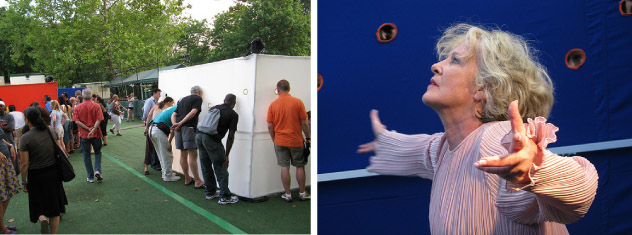
PeepDance by Nimrod Freed (dancer: Nira Trifon). Photo: Shira Golding
In ‘Sartrenian’ terms, the subject/object power balance between the performer and an audience vary in each of these possibilities: when the forth wall in impenetrable and the audience are tucked safely in their far away seats, the power balance shifts in favor of the audience since it cannot be objectified by the performer. On the other hand, when the separation between performer and audience is taken away, the situation is more balanced. They face each other ‘eye to eye’ and the potential for two-way gazing exists. But nevertheless, there is a special relationship going on between the performer and the audience – they don’t share an interpersonal space. Unlike Sartre walking in the park, the audience has the upper hand in the perceived space, even though it may seem the opposite, since the performer knows what’s coming – he has a plan/message/action. Sometimes he may even embarrass the viewer and thus place him in a compromised position. But, the audience has the upper hand since after all – he’s the viewer! He gazes at the choices made by the makers and the performers from the “outside”.
Erika Fischer-Lichte claims that even when the audience is manipulated into taking an active part in the show, the audience still continues to play its part, and remains separate from the performers. Jerzy Grotowski, who for many years dealt with the audience/performers relationship, shifted away from theatre exactly for that reason: he realized that there will forever be an asymmetry in the audience/performer relationship. In a proscenium arch theatre as well as in a performance which maintains a unity of space and time and does not rely on fictitious elements – it’s impossible to escape the unbridgeable separation between audience and performers; the performer has a certain knowledge (planning, rehearsals, or even just the mere decision to use a particular space in the case of complete improvisations), while the viewer comes to see something that already pre-framed fro his gaze. The audience, merely because of being a viewer, will forever function as an outsider, an onlooker.
The protagonist in Sartre’s book Erostratus, enjoys looking at the passers by from his 6th floor window. He feels it gives him an advantage over other people. In his words, it’s a “merely circumstantial advantage: I have positioned myself above other humans and I ponder over them”. The audience enjoys the same dynamic: similarly to Sartre’s protagonist, they can “watch people from above” – look at the performer from an invisible distance. Erostratus’ poetic metaphor touches the very core of this discussion: the audience and the performer are not positioned on the same terrain: while the performers are obliged to walk the path of the show blindly, the viewer does not share their field of action and is thus devoid of responsibility. The viewer has power – as an outside guest, he’s free to examine the situation externally, as an onlooker, a peeper.
In the summer of 2008 I performed in Nimrod Freed’s PeepDance as part of Summer Stage Festival in Central Park, NY. Freed wanted to intensify the voyeuristic nature of performance, and created a kind of ‘peepers village’. Seven booths sized 3x3m were scattered in an open space designated for the festival. Each booth had twenty-five peeping holes at various heights and one female or male dancer in it. All the booths were active simultaneously and had one dancer improvising in it their interpretation of the same sound-score (performers were Ofra Idel, Shani Britner, Yoav Grinberg, Merav Dagan, Nira Triffon, Elinor Chertok, Yaron Shamir and myself).
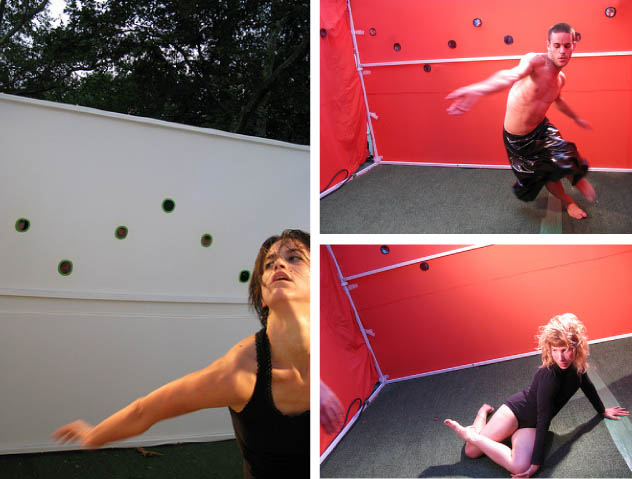
PeepDance by Nimrod Freed (dancers: Lior Avizoor, Yoav Grinberg, Merav Dagan). Photo: Shira Golding
Fifteen minutes prior to the audience arriving we went into the booths. When the audience came it was still daylight and it was hard to distinguish the external light from the one within each booth. The conglomeration of booths seemed like a colorful installation that didn’t give away what was happening inside. The music was playing in the background and from inside the booth I could feel the chit-chatting audience’s awkwardness, not understanding where the ‘performance’ was taking place.
Inside the booth and while moving, I scanned the peepholes and waited for someone to look inside. The feeling I had of people not looking at me, lead me to stop moving. I realized that my motivation to move was related to being seen. After five long minutes, the audience noticed there was something happening inside the booths and the holes were filled with eyes.
Separated from their faces and bodies, the audiences were reduced from individuals, to mere gazing entities. Each gaze was like a kind of a ‘coin’ that from the moment it was brought into the booth, it made me ‘do things’. Gradually I noticed a sense of unease; it was as if their gazes forced me “to do a trick”.
Since I could see nothing but eye sockets and camera lenses, a radically asymmetric relationship had evolved; I became a kind of ‘seen but not seeing’ entity – weak and helpless as if I was on placed on someone’s gun sight – while the audience were covered in an invisibility cloak, offered to them by the architecture of the performance space.
I realized my only weapon is to stare back. Eye for an eye. I fixed my eyes inside the holes, spoke with the audience members on their viewing experience, and confronted them with the invasive scenario.
Despite the sense of regaining control and feeling that I had the upper hand, the audience had ‘won’. No matter how many times I stare back, no matter how aware of the situation I am or what conceptual tricks I use – the audience will always be able to view me from the “window on the 6th floor”. I am being watched, and they are the spectators.
From English: Sivan Gabrielovich - Gal
1 All quotes are free translation from the Hebrew version of the text.
Lior Avizoor is a PhD student at The Tel Aviv University. Lior has danced, taught and created performances throughout Europe, Mexico and the U.S. Since she returned to her native Israel Lior is devoted to widening the local discourse around the performing arts. Lior is the co-editor of Maakaf on-line magazine and the co-artistic director of Room Dance Festival. She is curating exhibitions, initiating conferences and working as a dramaturge for dance productions. Lior teaches at the Beit Zvi Acting School and at the Kelim School for Choreography.