


Practice of Re-Distribution


- Details
Noa Mark-Ofer
Practice of Re-Distribution
Bojana Bauer is a dance and performance theorist and a dramaturge. She received professional dance training in Belgrade and was a member of the National Theatre Ballet. She studied dance theory and aesthetics at the University Paris 8, where she is currently teaching.
After being active as a producer in Alkantara Festival in Lisbon, she is based in Paris since 2007. She is active in public talks and lectures in various institutions across Europe. As a dramaturge, she has been collaborating with choreographers Latifa Lâabissi, Vera Mantero, Mário Afonso, and the visual and performance artist Pedro Gomez-Egaña.
The breadth of her practice, covering rigid dance technique to philosophical writing, through accompanying contemporary creation processes, has led me to converse with Bauer of dramaturgy in dance and the visual arts from a broader perspective.
You have started as a classical dancer. Could you reflect on the detour that led you to practice performance from a very different angle?
For some time it felt more as a disconnection – the change of career, but as I was digging more into my theory and practice, the more my experience as a dancer was resurfacing. The pool of questions and experiences were becoming very helpful. As a classical dancer I wasn't in a context where questions were welcomed. As an 18 years old dancer I wanted to go in depth into my practice in terms of knowledge. In the French School for Teaching they were suspicious regarding why I wanted to become a teacher at such a young age. That confronted me very early with the hierarchies of ballet: you're a student, then you're a dancer, then when you're old enough – you can teach. You are fed with certain knowledge and as a dancer you're not supposed to know what your teacher knows. So these power dynamics were prevalent from the beginning. It was in Alkantara Festival in Portugal, that I have started to realize what my context of work would be. After working there as a researcher and coordinator, my work as a dramaturge began.
Why do we need a dramaturge? Isn't that simply a distribution of labor?
We don't need a dramaturge. It's not a necessity for any given production. I don't believe a dramaturge can function as a “fixer”. If it becomes a work of consulting – it stops being dramaturgy for me. Even though dramaturgy has emerged so massively in the historical context in the mid 90's, we can retrace it historically (even though it wasn't named as such) and understand what made it become institutionalized. That's partly what my dissertation is about...
The notion of dramaturgy stirred up some interesting questions, but these were not necessarily new and were prevalent before, it were the answers that exposed different perspectives and problems of the distribution of labor and changes in configurations of the creation and of performing arts market in Europe. And I specifically talk about Western Europe because it reflects different economic dynamics than in North America for instance.
In Europe, the emergence of dramaturgy coincided with moments of economic changes that were also political demands of artists, dismantling stable companies. It was a liberating discourse that they got caught up in. So you can say that dramaturgy emerges in that context as a symptom, but simultaneously as a tool to think.
Politics are usually connected to terminologies and in your writing you use the term “production dramaturge”. Could you elaborate on this use of the term?
In dance you don't have a "in-house" dramaturge (except for Germany, where it is really institutionalized). Most of us are freelance or teach in universities, and for me dramaturgy works within a creative process (this very notion is still a broad term) and therefore I discuss it in terms of poetics and not aesthetics.
Isn't being a dramaturge equivalent to the intellectual coming into the studio? Isn't it preserving those known hierarchies? Perpetuating old binaries of theory and practice?
I do not think dramaturgy bridges theory and practice even though that's the way in which it is often described. It's not about interpretation - I don't think of it in those terms. I think it's there to develop tools (and not interpretative ones). The standard hermeneutic approach is not useful for me in making performances. It is a matter of procedures and logics that will be invented for every given project. It is very much a matter of principles - not in a normative sense, not those that pre-exist in the creation, but those that are forced to be invented into the creation. That takes us to the political issue, and it might sound hermetic, but in a way dramaturgy is “closed” (that's a political issue in relation to how it reaches or doesn't reach audiences). Dramaturgy does not mediate between the creation and its audience and therefore that should not be one of its objectives. It creates a creation and then that creation does whatever it does to the audience. It is political because historically, institutionalized dramaturgy would do exactly that: it would produce program texts that would communicate with the audiences. But the institutionalized dramaturgy does not interest me - that's definitely not my practice. A dramaturg is often described as the “first spectator”, but I don't see myself as such, but rather as A spectator. In other words, for me, dramaturgy is about Spectatorship and not mediation. I see myself as a future spectator of a work – not patronizing and "explaining" the work. It is completely inherent in the poetic process and within that process it develops tools that help us think of how to make it. Art is not meant to be easily and immediately understandable. Dramaturgical work is not something that should "easily" send the message across – that's what marketing does!
But at the end of the day, the dramaturge is there to promote some kind of a process. And even though we prefer not to be caught up in the coherent/incoherent binary, we are looking for a narrative, an idea or even just a sensation to come across…
Coherency is a difficult term - sometimes I would like to dismiss it altogether. Dramaturgy works in the realm of logic of procedures, not aesthetic procedural work but rather in the layer of artistic gesture – let's say a collage. Coherency is not something I relate to and that is why I don't refer to dramaturgy as an interpretative reading. I "read" these images and then I respond. I don't interpret – and if so, only to HOW? If I interpret anything it is how logics are employed to make the performance. So if I talk about logic, yes, there is always some level of coherency: is it logical or not?! Coherency goes together with coherent structures and that bothers me, because it doesn't apply to contemporary dance today in the sense of having a narrative structure or material gestures in the work etc. Dramaturgy in many respects is to play with what is not "efficient". It can be coherency of not being coherent – a logical paradox of contemporary creation (we do have a heritage of strategies that work and we know what is effective). When I think of myself in the process, I am there to complicate things in the sense that it forces everyone, me included, to rethink things. It is actually a practice of re-distribution.
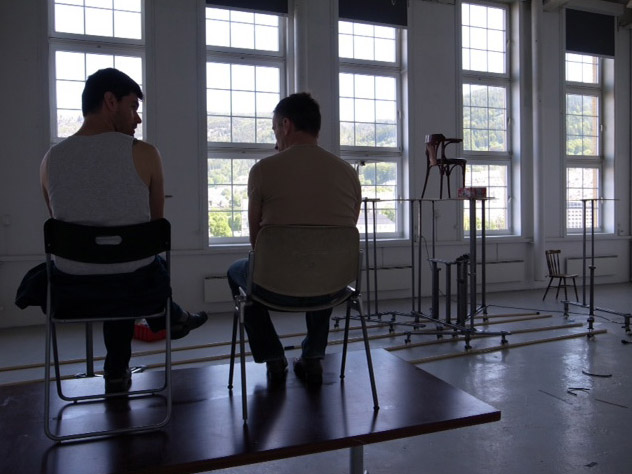
studio rehearsals of Pedro Gomez Egaña and Erik Houllier in Bergen, Norway (2010)
You have worked with the visual artist Pedro Gomez Egana. Is there a dramaturgy of visual arts? Which is to ask: Are these different practices?
With Egana, the function was similar because we did a performance in which he questioned issues of time and theatricality. So it brought it home to me. It is a different field of expression from dance. The questions I was approaching with him were questions of time, of temporality, production of alert and catastrophic temporality in media. This was something we were not necessarily illustrating but rather a starting point. We tackled it in a performative way that by definition produces temporality and exists in time. It both made us look at theories of temporality, memory and trauma – and concretely made us develop tools to produce a performance. In that sense, I was working within my usual pool of questions.
The interesting thing was the dynamics of the work itself; I “needed” rehearsals even though we had nothing to rehearse. We were working with sketches and drawings which were hard for me – it was challenging to visualize what would actually happen in the performance. When we had the installation ready, I suddenly had a realization of things which produced new questions and ideas. It is actually similar to what happens in the processes of choreography: you speculate on something, and then you materialize it, and then conceptualize it again. The open dialogue with Egana made it possible for us to change each other's processes, which was interesting. While I needed that materialization again and again, he was fulfilled with a singular materialization. As a visual artist, it was sometimes sooner clearer for him because he doesn't have the tendency of the "experience" and the obsessive need to contextualize the exposure like you have in dance – he was free and thought of the temporality of exposure that was worked on.
This brings us to the question of knowledge…
The question of knowledge was already in my pool of interest. Egana's way of articulating problems (even the vocabulary he used) and his relation to the material he was producing was not the same as with dancers. He was able to be distant from the experience, even though he was performing. Egana's discourse is not in the physical level – he objectifies his work much more than a dancer could, and is able to be an outside eye. I guess that stems from the visual arts training; the precision of articulating questions is like a cultural thing. What he lacked was the ability to articulate his own performance. I found myself sometimes working as a choreographer, offering him my advice on how to work with his body – reaching out to my practical experience. When I'm with dancers I am not proposing bodily practices.
As a Serbian dramaturge living and working in Paris, do you feel like “local” methodologies exist?
The question is how to invent methodologies and then think of them locally. Local thinking is not reserved for the margins anymore. For me, that means how to think for example about Paris locally even though it has this mode of function that is very specific to a place that has been a cultural center for a long time and it has its own hierarchies and is very institutionalized. In such a place it's almost impossible for an artist/dramaturg to have an open dialogue with a programmer.
In that sense, this normalized and institutionalized Paris is not thought of as a context. It's a window, a place to act and create and simultaneously be critical about this sclerotic mode of functioning relating to theaters and subsidies and money…I would say that the same anthropology should be applied to Paris as it is applied to Belgrad.
Bojana Bauer is a dance and performance theorist and a dramaturge. She is currently carrying out a PhD in aesthetics and theory of performing arts at EDESTA - University Paris 8, supported by the portuguese foundation FCT. She has been teaching performance and dance theory at Paris 8 University and École Supérieure des Beaux-Arts de Nantes Métropole. She is active as a lecturer in several Master programs in choreography and performance, such as Ex.e.r.ce at CCN Montpellier in France, or ArtEZ and DasArts in Holland, as well as at the National Academy of the Arts in Bergen, Norway. She has been collaborating with choreographers Latifa Lâabissi, Vera Mantero, Mário Afonso, Ivana Müller and the visual and performance artist Pedro Gomez-Egaña. Bauer's writing and essays are published in Repères, The Walking Theory, Maska, and Performance Research amongst others.
Noa Mark-Ofer is a dancer, creator. Graduated with honors from Columbia University New-York (Dance Studies, Gender Studies). Finishing her M.A. thesis in Performance Studies from Tel Aviv University. Performed with "Mayumana" group for 4 years and worked with different choreographers in New-York and Israel. Teaching contemporary dance at "Beit Zvi" School for Acting. Artistic director of art festivals and events ("Advot" - choreography lab, "Beshutaf" - women in performance, "Boydem" - Bikurei Ha'itim Center for the Arts).