Re-Organizing Anew

- Details
Monica Gillette
Re-Organizing Anew
Analogies between dance dramaturgy and film editing
My relationship to dramaturgy has been informed and developed while working actively in two separate fields. First, is a near life long experience with dance and a career as a dancer and choreographer. Second, is the time I spent working as a film editor in Hollywood, which will be my main focus for this article. For me, film editing is about timing, pacing, rhythm, juxtaposition of shots and sequences for ultimate dramatic tension, similar to a choreographic process. When I worked as an editor, primarily on different television series, editing initially provided another outlet where I could connect to my instincts developed through dance and choreography and all of its musical and performative range. Now, my experience as a film editor directly effects my current projects in dance creation and dramaturgical questioning. With editing, I gained a tool-set of choice making skills and a path of reflecting and analyzing material that leads towards the sharpening of an idea or a theme. Moreover, it leads to the possibility of shaping a strongly developed structure, which in the performance world is how I relate to dramaturgy.
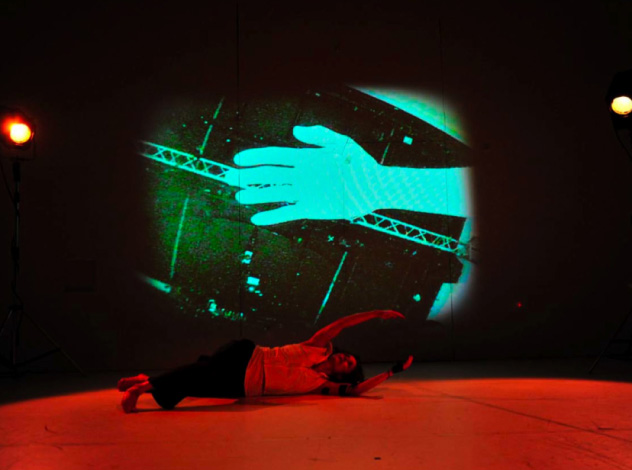
Virus, by and with Monica Gillette, Tom Schneider & Jens Dreske (photo: Maurice Korbel)
Constructing the raw material
The first level of comparison I would like to make between film editing and dramaturgy is one of language and pathways towards constructing material. At the time I was discovering film editing, the field was debating the very term 'film editing' because it was the moment when the technology was shifting from being shot and edited on film to being shot and edited digitally. It was also the moment of change from linear to non-linear editing. To quickly explain, prior to the digital days, to make an edit, one had to commit much more to a decision making process because the shots had to be selected and then literally cut apart by a little mini guillotine and then re-spliced together with tape to create a sequence of shots, or a scene. Nowadays, with digital editing, shots can be quickly moved around without any consequence to a work print. In the guillotine and splicing days, one had to map out an edit in the head or with notecards on the wall, or make 'paper edits' and look at possible combinations of shots with a lot more discipline and intention on what one really wanted to say before making a single splice. With the revolutionary digital age of editing, one can dive into the material and do almost anything with it: Shots can be slipped forward and back, layered, jump cut, juxtaposed and much more.
Both cases - the 'old school' editing and the new digital editing - hold analogies to dramaturgy. The 'old school' act of linear based film editing, is like the first layer of asking the question, what do you want to say? What is your intention with the scene? It can be a direct tool for guiding the point and direction of the material being created or edited. On the other side, is the digital, non-linear path of editing, which is by far more flexible and plastic in its process by the very ability to move things around so freely. This type of plasticity can be an exciting way to open possibilities of how material can be used, yet it can also create a soup of interesting, or even 'looks cool' material, while being lost with no back bone or clear theme.
Reformulating the raw material
While my initial attraction to film editing was based on the more superficial excitement of playing with rhythm and timing, I quickly learned lessons that took me further into understanding the power to say many different things with the very same material. My first job out of university was as an assistant editor on one of the just becoming horribly popular reality TV shows. We had six hundred hours of material and we had to edit it down to a four hour, two part miniseries. There was no script before shooting, but a sketched outline of what one could imagine might happen, (which can be compared to hundreds of hours of improvised movement material in the studio, and then a search for how to put it all together or sculpt it into a live performance). For this type of non-fiction, or documentary editing, it means the actual 'writing' of the story happens in the editing room. On that questionable reality TV show, is where I first realized we had enough material to make everyone look good, or everyone look bad. We got to decide who were the heroes, the outcast, the bad guys, the ugly duckling and the most liked - simply through choosing what went in the edit and what we cut out. This was the first lesson for me to realize that we could say anything we wanted, but the more important questions was what did we want to say. What was the story we wanted to tell from all those hundreds of hours of footage.
This type of plasticity or flexibility in viewing material has now become an active tool for me in the studio while searching for a dramaturgical structure or statement; just as a performer can change how material is performed through a change of intention or thought behind movement or speech, an editor can change the intention of a scene when just a few shots are cut out, a single line is cut, a reaction shot is swapped for another take or the music is cued just a few beats later. In video editing, there are literally 30 frames per second, and each frame is editable. While the duration of a second is just a flash, over time, an editor can literally feel the difference of just a couple of frames (and there is even an affectionate term in the field call 'frame fucking,' which means you obsess back and forth on a few frames within every shot in a scene). It can be likened to a choreographer or dancer 'cleaning' a phrase where they go over details with much more precision and nuance so that things are timed better or more in sync among the performers. In the editing room, it is the difference between when a scene feels unintentionally sloppy, or when the shots kind of 'click' together and feel like they belong side by side. In live performance, this type of obsession for detail can either make something go to the next level, or it can make something that is supposed to be more spontaneous become flat and blocked. But the main point from the perspective of dramaturgy is that this type of zooming in on the details whether it is setting something with more precision or further clarifying the aim or intention of a live sequence or improvisation, can give an overall sharpness to a concept, and globally a stronger statement with the structure and the work in general.
Interpretation of the raw material
Another parallel concept I have found between the field of editing and dramaturgy, is the idea of 'interpretation.' As an editor, when I would sit in the editing room - the raw material on the computer in front of me and the director often sitting behind me - I became a middle man of sorts between what the director wanted and what the captured material actually was. Often, the directors I worked with didn't possess the editing language to say exactly what to do or had a shady memory of what ended up as shot material (versus what happened on the set). As the editor, I would try to listen very closely to all that they were asking for (as well as everything unsaid or simply implied) and then I would try to sculpt the material into what they were envisioning, sometimes making multiple versions of single scenes, or 'cheating' shots from anywhere I could find them to give the illusion of what the director was searching for - I had to be a reflector and interpreter of their vision.
In my opinion, a good dramaturg does the same; A good dramaturg is there to listen really closely to what the choreographer is trying to achieve, and then offer up all sorts of questions, reflections, provocations, alternative options to make sure the material being formulated is landing somewhere close to what the original idea for the creation was. The dramaturg's role is to help drive the material further so it can reach a maximum level of consequence in the desired direction.
Looking at the material with a Fresh Eye
Yet another comparison I would like to make between film editing and dramaturgy is the aspect of fresh "outside" eye; When an editor sits in front of the raw material for the first time, the first reactions to the material are often the most important, because upon multiple viewings, a desensitization will set in as well as a closer relationship with the material which will both facilitate a deeper research, but also narrow the ability of the creators to see the edited outcomes more neutrally. Moments of what one thinks the construction of shots is saying may begin to blur with what the edit is actually saying.
When working with a dramaturg in a performance process, ideally that person can serve both as an outside observer who can stay fresh to what the material is producing, and at the same time be closely connected to what the intent or desired statement or aim is. In a recent creation process for Misalliance, a piece I am currently co-creating and performing with Clint Lutes, we decided to use a series of rehearsals open to the public as a way to experiment with the public as dramaturg. Each week, we have shown them excerpts of new material and then asked them basic questions such as, "What did you see?," What effect did it have on you?," "Was there something you missed?" In this way, we have been able to directly discover if what we are producing is what we thought or wanted to produce and if we are creating the environment we desire. It has provided us with exciting insight into how people are viewing and what types of expectations they enter a theater with, which has directly effected how we further create and perform the material.
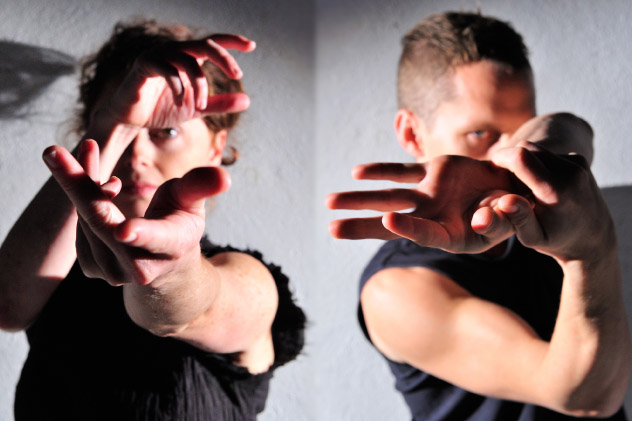
Misalliance, created and performed by Monica Gillette and Clint Lutes. (photo: Maurice Korbel)
Questioning the material- What is Missing?
Another concept I borrowed from film editing to dramaturgical thinking of a performance is questioning 'what is missing?'. I learned it while working with highly skilled, Oscar winning documentary storytellers when editing non-fiction, because one does not have a script to follow, and is 'writing' with the audio and images captured while in the field. There is a search to tell a story that is both true to what actually happened, yet also tries to serve what one wants to say (and not just what happened). Sometimes a story that we wished to tell, didn't directly exist in the material that was shot, and by asking what we missed, often we were able to pull shots from different directions to create the desired effect (but still stay true to the spirit of the subjects).
In the creation process of a live performance, I find this question equally helpful in generating new material as well as looking at a freshly sculpted dramaturgical structure and questioning it in a way that can possibly generate an outcome that will make it stronger. It can contribute to a process of discipline to drive material further and sculpt it into a statement, rather than leave it in it's first improvised or initially generated moment.
Most of the time, the material I was editing while working in Hollywood had an obligation to get plot points across while telling a story. In the dance and performance realm I am currently involved in, abstraction tends to reign much stronger than linear narrative or storytelling. Regardless, the tools of editing and how I compare it to dramaturgy on the level of examining and questioning material can still apply by asking what does the material say, and what do you want it to say. Just as with how all the cool digital possibilities with video editing can make something quite flashy and exciting, but possibly aimless and thin, so it can also happen in the studio when creating a live performance. It can be easy to settle on something performed well, but taking a work to the 'next level' so to speak, involves a further critical examination of what the intention and point the material should aim for.
Conclusion
Ultimately, both the film editor and dramaturg serve as an extension of the director’s or choreographer’s aim. They are there to reflect, examine, and assist the creator (film director or choreographer) in pushing the material as far as it can go in the direction of the desired statement. The tools used in editing and dramaturgy exist to support paths towards lengthening and extending the possibility of creation. With this in mind, I like to imagine ways to explore and apply these logics to areas outside the Arts and Performance realm and into the questioning of applied logics to other fields with the interest to discover new paths towards problem solving and ways to look at what is before us, re-organized anew.
Monica Gillette is a dancer, choreographer and film editor born in Los Angeles and currently based in Freiburg, Germany, working at Theater Freiburg since 2008. In 2007, she was a danceWEB scholarship recipient at Impulstanz in Vienna and is part of the international artist driven network Sweet and Tender Collaborations. She attended film school at Loyola Marymount University in California and worked in Hollywood as a film editor on such shows as 'The Sopranos' and 'Crime & Punishment' as well as editing several TEDtalks for the TED Conferences on TED.com.