


Hate Radio


- Details
Guy Gutman
Hate Radio
Between documentary and truth
Last December an exhibition called Die Enthüllung des Realen (the revelation of reality), opened in Berlin’s Sophiensaele. The exhibition is a retrospective of the years 2009 to 2012 in the work of performance group IIPM (International Institute of Political Murder), led by director Milo Rau. The decision to create a retrospective to a director who’s been active for a relatively short time is a proof for the significant influence his work has had on theatrical discourse, and for its tendency to raise political controversy. Rau’s works include artistic reenactments of historical trials, such as his The Last Hours Of Elena And Nicolae Ceausescu, which reenacts the trial of the Romanian dictator and his spouse, accused of corruption and crimes against the Romanian people, as well as The Moscow Trials, dealing with the political trial held against Russian band Pussy Riot.
The exhibition’s main space was dedicated to the performance of Hate Radio, the ensemble’s most charged and controversial work. Hate Radio reenacts - or restages –Rwanda’s RTLM radio station, which played a significant role in the 1994 Rwandan Genocide. The performance, which I had a chance to watch during the Homo Novus festival in Riga, Latvia, is staged as an actual radio broadcastin-g. The audience sits on both sides of a transparent radio studio, and actors play the original broadcasters. The audience listens to the performance/broadcasting with the help of earphones, which makes the space become intimate and the already loaded content even more powerful.
I interviewed Milo Rau about two weeks before the show opened in Berlin. This was an opportunity to look at the processes and dilemmas behind his work from a larger perspective.
The performance of Hate Radio at the Homo Novus festival in Riga resulted in many discussions and polemics about its politics and about the history of Rwanda. However there was very little talk about the form of the piece or its aesthetics, which is extremely rare in today's theatre.
In this particular moment we are living in, this moment of theatre history, I think it is quite extraordinary that there is no discussion about form, especially because there are a lot of formal choices in the play. For example, the fact that the actors are connected to what they play in a certain way, or the fact that they are playing different roles, or that there are various medias being used, or that there is a very strict realism and so on and so on. But I think all that is only behind what one might call content. The important thing was just to give an insight into Hate Radio.
On the other hand, all you can see in this one hour of radio is absolutely artificial. Many things were invented. I presume they never played Nirvana for example. Yet, when we showed it in Kigali every one told us "it was absolutely like this".
I went deeply into the archive but in the play I tried to make a new RTLM because if you listened to it now like it was broadcasted in 1994 your main experience would be of an old-fashion program. It would not really reflect the situation of that time. And so we mainly tried to convey the experience of it to a contemporary audience, to bring the coolness, the jokes, pop culture and political impact. RTLM was the first radio station to in Rwanda to use that kind of tone, to say on radio words like "prostitute". So the main question was how it felt to a whole population in 1994, and then how to translate that to a theatre piece in 2013. This was the problematic aspect of making Hate Radio. My view is that theatre doesn’t function as a tool of information – in an historical accuracy, as a documentary. It is a truth of memory more than a strict historical truth.
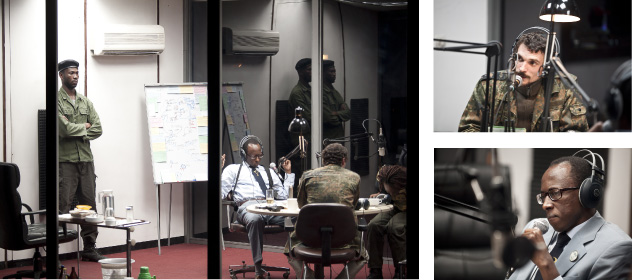
Hate Radio. Photo: Daniel Seiffe
In regard to your reflection about the function of contemporary theater, it seems that Hate Radio operates in the tension between epic and naturalist traditions almost simultaneously. How do you place Reenactment within the diversity of 20th century theatrical discourse?
My research of reenactment took different forms over the years but I feel that in Hate Radio I moved away from pure reenactment because what we see on the scene is a total invention. It's a new RTLM yet truthful to the way it is remembered. What we are trying to reenact is a discourse of hate and not necessarily a particular broadcast. We had the experience of trying to change the text in the show, make new versions in different countries, and realized that by changing 20 words we have in fact a universal situation that can be placed anywhere.
So this is a fake documentation if you like. What I wanted to show is a kind of presence. I think that until recently the notion of presence, at least in German theatre is mainly coming from the influence of Performance Art in the 90's. Following that notion, the approach for Hate Radio would be that we will not give you a background or a staging, only convey the presence of the radio and either you understand or you don’t. So, it's a very non-postmodern thing – to insist that it is not about the presence of the actors, or the presence of the authentic reenactment, but a presence of an absence, a representation. You can say that we are using postmodern strategies to do the most non-postmodern thing, which is to represent something that is absent.
That is why, when I started doing reenactments in 2008-2009, I was often accused of going back to the naturalism of the end of the 19th century, but I believe that we examine it in a very different historical, intellectual and formal context. From the beginning, we were breaking strongly from what was on at that time on the German stage, where there was always a sort of Brechtian Irony, where the performer is always divided, and where he is only present, like in Marina Abramovic's works, when he brings his own body, his own biography.
In contrast, we tried to return to Stanislavsky but in another mode of history.
In recent years, there are many reenactment projects that are very authentic, almost autobiographical- which is politically problematic, and on the other hand there are reenactment projects that try to convey a distance between the action and what is reenacted in order to create a postmodern play. So, for example, they will reenact a seminal chorography from the 60's and turn it into an ironic display. I feel that what I'm trying to do is reintroduce the notion of representation on stage.
Taking from what you say, I might even suggest that your work acts as a Greek Tragedy.
It is a display of a myth. I think Greek tragedies are a very good way of understanding what we are trying to do. For example in The Last Hours Of Elena And Nicolae Ceausescu it is the myth of the founding of the Romanian democracy - which is the video of their trial. It is very similar to the myth of the founding of a Greek city. The first question everyone asked me in Romania is - "why do you bring it to the stage, everybody knows it in detail, you can't tell us anything new" - and they are absolutely right. But that is not the question, because theater is not a medium of information. That is why whenever I go to Documentary Theatre I always think that I can just as well check out Wikipedia and get the same information.
What I really want is to enter a situation anew. A situation everybody knows and can now re-live intellectually.
In the Greek theatre everybody knows what happens to Oedipus or Antigone, that's not the question. It's about living it together again, as if the ending is unknown to us, and that is what a myth essentially does. In Germany our theatrical myths are Euripides, Shakespeare and Chekhov, but today we're immersed in new myths like Nirvana's songs for example. For the people of Romania the images of the Ceausescu trials are the myths of our time and we need to confront them as they are still un-understandable and traumatic. This is why we are constantly returning to popular events like Kurt Cubain's suicide. Even after 20 year, we come up with new details, new biographies, we still play Nirvana songs on the radio. It’s not only that the songs are good or bad - they are somehow important to us.
Except from your theatre projects, you have also worked with a variety of mediums ranging from video to fine art installations. What do you see as the particular quality of the stage that is different in the way it articulates the political?
That's a good question. In an article about Ceausescu I realized that everybody thinks he has seen the whole video - which is impossible. First, the whole video is inaccessible. They might know fragments but they don't have the whole hour. Even the full video depicts only a small detail of the whole room. That is why it is very interesting to have the whole room on stage almost in an Aristotle way - same room and same time in chronology. It is there that you can see the whole elite of modern Romania on stage killing their own leader and founding a new democracy. So it becomes a theatrical and political situation where the viewer has to stay present for the whole duration of the two hours trial even if he is bored. That is entirely different from what we're used to today as cultural consumers, where in exhibitions for example, the bored viewer just walks away after 5 minutes.
A lot of your works deal with trials in different forms and perspectives. In the trial we do not see the actual event but rather take part in a process where the event is being discussed and reenacted. How do you see this kind of process and how important is it in your work?
On the one hand you are right; on the other hand I would argue that a trial is also an event. It is a very specific form of discussion. It conveys the tensions of seeking truth, of losing or winning, of drama. When you have a trial like the Moscow trial, where people are really eager to win, they are performing in an event. That is why when they reply in a cross-examination they are not speaking from the outside but rather they are in a situation and they are fighting. That situation is also a very important theatrical condition that allows us, the performers, to maintain the tension every evening we play, as we ourselves are put in that situation. Very often you would see in theatre that actors change their performance after the 20th-30th show. They begin to stand outside of their figures and it becomes about looking ironically at the play and about them looking at themselves from the outside. This can be very charming but I think this is no longer interesting at the beginning of the 21st century. We have been doing this for 60 years. I am interested in creating an engaging event that is both emotional and at the same time is not afraid of boring the audience.
Do you see your work as an observation about the way the theatrical and performative operate within the political mechanism?
We could go back to the sociologist Richard Sennet who wrote in The Fall of Public Man, that politics has to exist in the public sphere, which means that you are no longer present as Guy Gutman or Milo Rau, but rather as a representative of a political party, or the president - as a theatrical figure, and what we lose now in the postmodern area is the difference between both.
For example in Germany, the trials we have of public figures are usually about misconduct in their private lives. I see this as a problem and agree with Sennet that we all need to share public spaces where we are no longer present as Milo Rau but rather a public function where we can be heroic, or have heroic moments even by voting, where we are in another sphere.
Like in a Greek drama, I think It is very important to try and understand performance and theatre as a possibility of having a public space - and to do so without irony and in all seriousness.
Milo Rau was born in Bern, Switzerland in 1977. He displays his many talents as a Director, Playwright, Journalist, Essayist, Researcher, Conceptual Artist and Film Producer. In 2007 he founded the IIPM - International Institute of Political Murder. He uses many methods, such as theater, fine art and film in searching for ways to reproduce historical events while moving things along a theoretical plane.