


Marina Abramović’s Time


- Details
Abigail Levine
Marina Abramović’s Time
Retrospective and Reperformance at the Museum of Modern Art
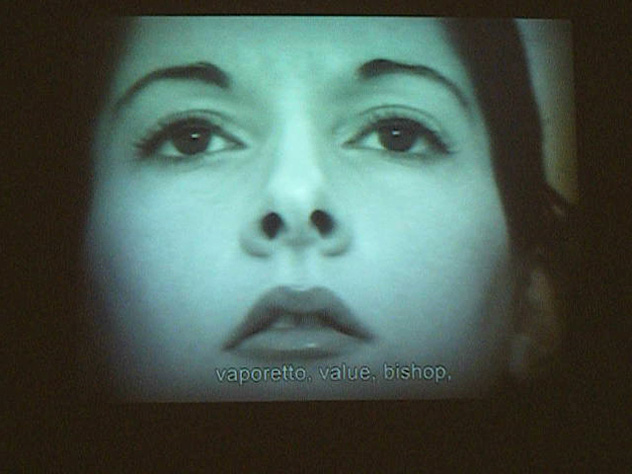
video still: Freeing The Memory, 1976
Marina's Present
Her gaze fixed, Marina recites, “vaporetto, value, bishop, humidity, Anastasia, euthanasia...” (Abramović 1976). On the corner of a gallery wall, under the persistent cries of “The Artist Must Be Beautiful” and sandwiched between the remains of the iconic “Rhythm 0” (72 objects for an audience to use to act on Abramović's body) and the two naked bodies of the reperformance of “Imponderabilia,” is the video documentation of “Freeing the Memory.” Abramović's face fills the video. She is almost completely still (a humorous challenge to video, which she often employs). Over the course of eight hours, she speaks every word she can think of, ostensibly until she has no more left in her mind. It is a simple yet mystical proposition—to empty the mind of words. The piece works on you, its various time signatures and rhythms evoking a disorientingly flexible experience of time.
In many of her works, through the use of durational performance, practiced concentration, and simple, direct contact with her audience, Abramović is able to facilitate an experience of time that is like few we have in contemporary life. For brief moments, time seems malleable, moving with no clear speed or direction. A teenage visitor to the show was reported as observing of those who sat with Abramović in her work The Artist is Present, “'I think they lose all perception of time when they get up there'” (Dwyer 2010).
Abramovic's 2010 retrospective at the New York Museum of Modern Art (MoMA), marked the complexities of temporal organization both within the works and in the proposals of the exhibit as a whole. In particular, her proposal of "reperformance"—the reenacting of previously performed works—as the definitive model of preserving performance art created controversy.
Was reperformance simply a stunt driven by the economics of the art world? Was it a betrayal of Abramović's own performance principles, including a prohibition on repetition, as laid out in her and Ulay's "Art Vital" manifesto? Could reperformances stand on their own as interesting works of art? How else might performance works be "kept alive"?
I was one of the 39 reperformers who trained with Abramovic and enacted her works daily over the course of two and a half months. I spent more than 120 hours practicing presence in near stillness in the exhibition galleries. Despite all the video, photos, and mythology pulling our performances into a static, historical narrative, Marina counseled us in an email after the first month of the show, that the only way to make it through the months of reperforming was, moment by moment, day by day, to remain present. In what temporality did these reperformances reside? What potential could we find in this tangle of presence, preserving, remembering and revivifying?
Retrospective Galleries
Abramović's exhibition literally walk through her career, divided into the improbably coherent periods of her work/life/philosophy: gallery one, her early solo works, which primarily challenge her own body and mind; gallery two: her twelve year-long “Art Vital” collaboration with Ulay, which tested the possibilities of one person in relation to another (specifically, a woman with a man); two more galleries cover Abramović's second solo period, during which a focus on her relation with her own body is exchanged for an engagement with her audience, and durational presence is prioritized over pain as mode of transcendence.
The documentation in the show—largely a mix of photographs, video, and digital displays that fall somewhere in between—is, itself, an interesting experiment in how to bring digital media's more frozen time closer to the affecting ephemerality of live performance. The most successful documents stood on their own as works of art. In their revisiting, they created something new. Most engrossing was a room dedicated to the twelve day-long performance The House With the Ocean View. In the original work, Abramović lived, fasted and shared eye and energetic contact with her audience from three cube-rooms ten feet off the ground. The presentation at the MoMA placed the empty cubes up on one wall, while a three-channel video of the entire performance played on another. Heard throughout the space was a 20-plus hour soundtrack of Abramović reading a transcript of everything she did during the twelve days: “I let my arms hang down straight by my sides. My fingers curve towards my thighs and there is a gap between them and my thumbs. I stand straight and still and remain looking at the audience. I blink. I breathe" (Abramović 2010).
The incantatory pace of Abramović's reading, the lack of synchronization between visual image and description, and the absence of a human presence in the set opened a space that invited the audience in, making it as much of an experiential work as those she had designed as participatory, such as the Green Dragon (a jade bench to lie on to absorb the mineral energy).
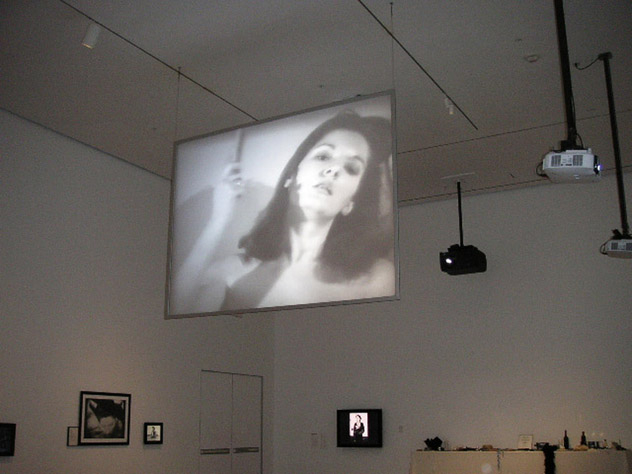
Documentation of Art Must Be Beautiful, Artist Must Be Beautiful (1975). Photo: Juri Onuki
The last gallery was turned over to video of Abramović’s 2005 reperformances of seminal performance art works at the Guggenheim Museum in New York City. The Guggenheim program, entitled Seven Easy Pieces, embodied Abramović’s proposal for how to re-perform works of performance art. The model proposed study of the “original” work, some reinterpretation or change of the work, display of documentation of the original work and, most importantly and controversially, securing permission from the artist or their estate to perform the work and paying for it (Abramović 2010).
The text went on to highlight the extent to which Abramović positioned these works as an answer to inadequate documentation, as well as locating performance art within the visual arts, rather than the performing arts world. This gallery, the exit point of the show, seemed to direct viewers towards a vision for the future of performance art as inevitably connected to the linear, archival project of the art museum.
Reperformances
In between the galleries or cut out of their spaces, were the five “reperformances” that were a part of the MoMA retrospective. These works, taken from the two later periods of Abramović’s career, produced an ongoing conversation among the performers, as well as viewers and critics. What exactly constitutes a work of performance art? Is it necessarily anchored to a particular social, historical context?
In her essay “Performance Remain”, Rebecca Schneider argues that “[i]n performance as memory, the pristine sameness of the ‘original’… is rendered impossible—or, if you will, mythic’” (Schneider 106). How would these reperformances stand next to the mythology of Marina and Ulay’s performances, as well as the material-documentary remains of the works? We struggled with these issues for their theoretical and historical interest, but more immediately in our commitment as performers to create affecting experiences for our audience within the structures we were given.
In the day-to-day work at the MoMA, the central question for the reperformances was: Do these performances, regardless of their historical referents, achieve relevance within their current context? Or, put another way, do these reinterpretations work?
Reperformance must, essentially, become performance, an exchange in the present. If the reperformances become effective only in relation to the “original” performance of the work, then they become a fragmentary form, another document. The curation of the MoMA show moved the reperformances, to an extent, towards reception as documentation. Of course, the very nature of a retrospective, a look back at an artist’s career, points to this historical, at times didactic, focus. Additionally, each performance was placed next to video documentation of Abramović performing the work, as well as explanations of the original context and, at times, the changes made to the work.
This juxtaposition was often a disempowering one for the performers and, I would suggest, for the audience as well. How much more difficult to bring an audience member into an experience in the present when it is preceded and followed with the definitive example, already in the past, of what that experience should look like and mean. The most striking curatorial pull towards reperformance as document was the lack of space for audience to sit and observe the performances.
Considering the emphasis on duration in Abramović's work and recognizing the importance of a community of observers to the success of the work The Artist is Present, it seemed a remarkable hamstringing of the works to rob them of the ability to effectively perform time in Abramović's model. Finally, the museum's management of risk in the performances, while unavoidable in such a setting, suggested that the uninterrupted image of the performers was paramount.
Abramović's selection and training of performers, however, pointed the works much more in the direction of reinterpretation, of creating performances, than faithful display. Many of the reperformers are practicing artists, more involved in creating their own work than performing in the work of other artists. Marina's instructions were minimal, leaving much more room for us to make choices and formulate our own understanding of the works than is characteristic of most directors.
Imponderabilia, for instance, was explained in the following manner: “You stand in the doorway, looking at the eyes of your partner. When someone passes through the door, you may look at them.” Our four-day training by Abramović, detailed by Judith Thurman in The New Yorker, focused not on imparting the details of her works, but on exercises that gave us the opportunity to find our interest and strength in durational activities, meditations, and pared-down existence.
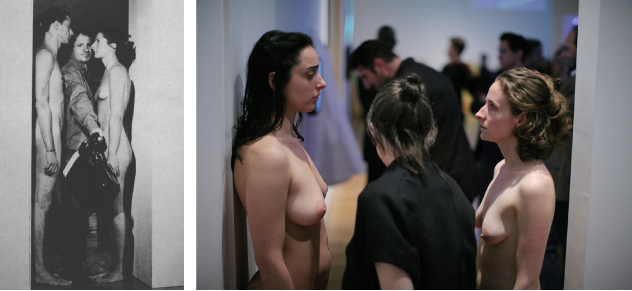
Left to right: Imponderabilia performed by Marina Abramovic/Ulay, 1977 ; Maria S.H.M. (left) and Abigail Levine reperformingImponderabilia, Marina Abramovic: The artist is present (2010). Photo: Scott Rudd
In an email to the reperformers (that serves to illustrate her flair for the dramatic in the same breath as she distances her work from theatre), Marina wrote, “My position about rehearsal is the following: Rehearsal is the enemy of performance art. In my entire life, I never rehearsed any performance I made. The preparation will be more focused on your state of mind than on your physical body. Long durational work is the most demanding type of performance, but it's also the most transforming.” And, then, we were left to do our work. Although there were many “official eyes” on the reperformance, Abramovic never came to the galleries to assess our work.
Three Months: Reperformance Over Time
In performance art, discovering what is being done and why it is happening has, logically, always been an important part of the audience's experience: What is Vito Acconci doing under that ramp? Why is Carolee Schneemann pulling that scroll out of her vagina? What will happen to Marina in that flaming star?
In reperformance, because the work has already been performed, the question of what will happen has largely been answered. It may be additionally foreclosed by a presenting institution's need for things to go as planned. The “why” gets fractured when the performance is divorced from the artist's initial impulse and context and, additionally, when the creating artist and performer were once, but are no longer, the same person.
What remains is the “how” of the work, the experiencing of the way the work is unfolding in time, the way the structure of the work is in dialogue with its context and the way it is being performed. Duration makes the how, the moment-to-moment experience of the work, as potent as the why or what. Duration was an issue often raised in regard to Marina's performance in The Artist is Present, but never in relation to the reperformances. This, however, was arguably the greatest transformation of the works from their originals and, certainly, where the presence of risk, singularity, and transformation reemer
It was also over time that the “what” and “why” of the performance were re-opened as questions. As the performers became attuned to the subtleties of crossings through the Imponderabilia doorway, contact with each passerby became a singular event, each with its own reasons and consequences. It was in the weeks of proximity and exchange that the security staff became active collaborators in the fulfillment of the works. It was over the course of the exhibit that these reperformances became works in their own right, for those performing and for many who viewed them.
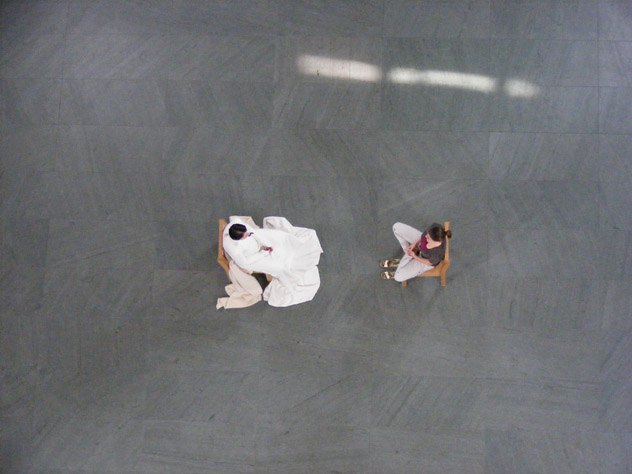
Marina Abramovic: The Artist Is Present (2010). Photo: Abigail Levine
In The Body as Archive, André Lepecki opens up another way to consider reperformance. Writing on recent reenactments of twentieth century dance works, he conceives “the dancer’s body as an endlessly creative, transformational archive” (Lepecki 2010, 46). This notion offers an understanding of Abramovic's interest in reperformance that is consistent with her teaching work with younger artists, and casts the MoMA show as a success in a manner not considered by most critics. From this perspective, reperformance becomes less about enlivening the image of the original work and more about continuing to activate and develop its meanings in and through artists’ bodies. Marina’s body is the ultimate archive of her performances; through our work at the MoMA, there are now forty additional bodies that carry and create from a particular understanding of her performance works and principles.
The future of performance art remains, happily, an open question. Reperformance may or may not become a definitive model in the future of performance art. However, it is clear that the 731 hours of these (re)performances—the practiced and concentrated energy of 39 performing artists in combination with Abramović's own formidable performance—had a literally exciting effect on the expansive space of the museum and those who worked in and visited it. No matter the ability of new media to keep works effectively animated, this exhibit was a strong case for keeping conversations about these works, about the art form, and about the issues they raise active between bodies.
This work is excerpted and adapted from its original publication in e-misférica, issue 7.2, After Truth (Winter 2010).
Works Cited:
Abramović, Marina. Audio: Seven Easy Pieces. MoMA Multimedia. 2010.
---. Email, January 15, 2010.
---. Video documentation of “Freeing the Memory.” Museum of Modern Art, New York.
“Marina Abramović: Seven Easy Pieces" exhibition text. Guggenheim Museum. November 5-12, 2005, 5pm-12 am.
“Marina Abramović: The Artist is Present” exhibition text. Klaus Biesenbach, curator. Museum of Modern Art, Donald B. and Catherine C. Marron Atrium.
Abramović, Marina and Klaus Peter Biesenbach. “The Room with an Ocean View.” Marina Abramović: The Artist in Present. New York: Museum of Modern Art, 2010.
Lepecki, André. "The Body as Archive: Will to Re-Enact and the Afterlives of Dances." Dance Research Journal, Vol 42, No 2. Winter 2010: 28-48.
Schneider, Rebecca. “Performance Remains.” Performance Research 6(2), 2001. pp. 100-108.
Abigail Levine is a dance and performance artist from New York. Her works have been shown in the US, Cuba, Venezuela, Mexico, Brazil and Taiwan. Abigail has performed most recently with Marina Abramović, Carolee Schneemann, Clarinda Mac Low, and Mark Dendy. She is currently co-editor of Movement Research's Critical Correspondence and holds a Bachelors in English and Dance from Wesleyan University and a Masters in Dance and Performance Studies from NYU. www.abigaillevine.com