


In Place, or Herzl and Me


- Details
Guy Biran
In Place, or Herzl and Me
On major milestones between Amsterdam and Jerusalem
One day back in 1998, I received a phone call from Hans Manintveld, Head of the AHK Theatre Department whom announced that my next annual production with his students will be a ‘location theatre’ project. It was my third year of teaching there, and I was still unsure as to coming back to teach the year after. The phone line was bad, and even in a direct conversation Hans was often unclear anyway. If I remember correctly he mentioned in that conversation that there is shortage of spaces within the school, and that’s how the location idea came about.
Since I was so curious with the offer, I didn’t give the reason for it two thoughts. I was already familiar with the dangers that lay in using variations of theatre – ‘physical theatre’, a commonly used title for a great many bad performances since Pina Bausch, all the way to ‘interdisciplinary theatre’, which I also run today, that may well be a cover story for personal caprices. Either way, at the end of that foggy conversation I found myself excitedly delving into a deep research of the notion of ‘place’ in theatre.
Back then I wasn’t familiar with the term site-specific. We’re talking about pre-google years – I was spending hours in libraries, wrote down notes and drew sketches, scribbled down thought in the wee hours of the night, consulted colleagues from the fields of philosophy, religion and theatre, and prepared a two-week workshop on the topic. When I arrived in Amsterdam in the winter, armed with inspiration, exercises I’d found and invented, I discovered, surprisingly, that my students knew about location theatre my more that I did, have seen quite a few shows of that genre in Holland and speak of it with ease, in the same manner we in Israel speak of say street theatre, a genre fundamentally different to site specific work.
Doing the workshop with the five students was no less that a revelation for me. For two weeks, in the December snow, we walked around Amsterdam’s nooks and crannies, creating works in underground construction sites, crowded touristy venues, abandoned buildings and busy city squares. A few strong works were created during that workshop, but mainly it served as a springing board for all the important questions, that I still grapple with when creating site-specific work. It can all be boiled down to two main issues – under-using and over-using the ‘site’ in a site-specific work.
In other words – how to use the site without ‘wasting’ it, and how to use it without over-using it? Or how to not force directorial ideas on it just to fill it. Sounds simple, but is in fact, quite hard.
Don’t fill it. Feel it.
The project continued to develop until it became a real school tradition. Each year we chose a different site to work in. the first year we performed in a hangar close to the Amsterdam port. The spaces in this huge building were given to various artists (Het Veem Theatre) who used them as studios, workshop and exhibition spaces, cafés and a theatre we had collaborated with. Each director chose a space they found inspiring, and began working from a personal topic of their choice. When I reflect back on it, I was pretty open back then, and went with the flow of the topics the makers had chosen, without worrying about the topics’ relevance to the space.
Although the rehearsals happened in the space, and slowly the work became very specific to the space we were working in, but using it was derived from that personal topic, and in effect could have happened in other venues as well. In the following years I became a bit more orthodox and made sure that the topic of choice would arise from the meeting with the space itself. We sat there for days on end, conjuring up associations, images and possible topics.
The second space we were working in was a large venue that used to be an apartment building in Jordaan, a beautiful suburb in the heart of Amsterdam. We decided to turn the entire building into a stylish hotel. The rooms were designed identically, in a minimalist and symbolic fashion, which gave it the feeling of an old European hotel. Downstairs we created a kind of a hotel lobby, and the audience literally walked into a hotel, with an appropriate reception. There was a lit up sign outside, and during the performances people would often walk in and ask to book a room.
One of the most important elements of site-specific work is the meeting point between the reality of a given space, and the performance taking place in it. A desirable outcome of such a performance is for the audience to walk into a made up world, that holds a kind of tension within it, which the viewer cannot ignore. Throughout the show, the reality confronts, or strengthens the created image, sometimes via threatening its limits, and either way, it does it in a way that isn’t self-explanatory, but rather leaves the audience the right and duty of assuming the meaning. It’s not a must for every space to assume an image different to what it naturally is. It’s a key question that needs to be investigated throughout the process. In any case it’s highly recommended for the space not to ‘pretend’ to be something it’s not, similarly to a desired relationship between an actor and the character they portray.
In our case the audience of course knew it they were coming to see a show, and we played around with the tension between a stylized performance form, and naturalism. Each room in the ‘hotel’ had audience members sit and glance at a different happening. At the end of the evening it became clear that the stories were all intertwined, although each one was performed independently and in a different performance style.
A year later we performed in a big farm on the outskirt of Amsterdam – a beautiful, picturesque place, with a large vegetable patch, a creek running through, animal farm, fruit bushes and water canals all around. The farm was used as a kind of social-communal space. After many conversations with random and frequent visitors of the farm, most of which were weird post communist types, we decided to turn the space into a rehabilitation centre for the mentally exhausted // burnt out (it’s an actual term commonly used in Holland, referring to people living with high stress levels, overworking themselves, who suddenly collapse for a few months, at home or in a sanatorium. I’ve only just recently heard a Hebrew term for it, perhaps since most of us in Israel live right on the edge of this phenomenon, it hadn’t been named). Here too, the audience came to a place with a clear imagined purpose – an open day at a sanatorium. Happenings of sorts were taking place at designated spaces within the building, while outside things were happening, within the so-called realist commonsense of the event, but, pretty soon the lines were crossed, and the show became very surreal, with symbolic images placed within the landscape, a band performing in the lake and a dinner table lowered down from a tall tree right above the audience.
One of the most interesting phenomena when working in a space inhabited by other people is that initially they tend to resist the artists, but later on relationships do begin to evolve, if the basic rules of respect and love for the space is maintained. Some of the patients even took part in the show and performed. When I went back to the farm to visit a year later, I found it in a deep crisis: the City of Amsterdam was about to give a private contractor a permit to build - a sanatorium for the mentally exhausted….
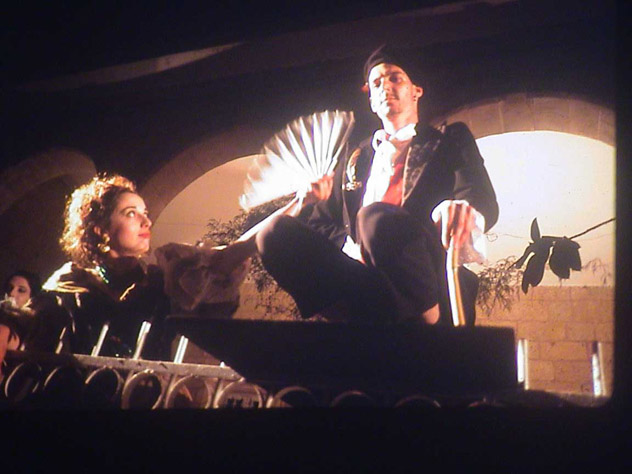
Altneuland, Dir. Guy Biran
So that I get a chance to get back to talking about Israel, via a short trip to India, I will only tell the story of my third year in Holland and about one more project. This time we worked in a huge closed space that back in the 1950’s was used as a garage for the city’s trams. The venue was going to be demolished – a saddening fact at most times, but a very good one for the project we were creating. It creates a dramatic tension, since it ties together the empty present time with a meaningful past, and an unknown, perhaps unwanted, future.
This time the space wasn’t imbued with one overall image, but rather a more abstract environment. We looked at the venue as a kind of a run-down, dilapidated historical bubble at the heart of a life filled metropolis, and a place of hiding, of solace. We used all its levels and floors, lifts, old cranes, which up to the demolition became a home for some adventurous residents. The sequence of performances was woven through with a thread of loneliness and a deep desire for intimacy. If it seemed that up until now I pointed at a certain way of creating site-specific work, it’s time to confess, that in recent years all my ideologies have started to crack. Only one principal remained throughout this entire time: the space itself decided the nature of the work.
It could be of course, that a maker will come with an idea and a topic and search for the right place. Personally I don’t work that way, but I’ve seen it work extremely well, like it did in Lotte Van Den Berg’s project, who is an ex-student of mine. At the end of her studies she created a few unique and awe-inspiring site-specific works. She asked me to come and work with her on one of them, for the huge Oerol Festival, dedicated in its entirety to site-specific work. It was in 2003, and I followed the work as a dramaturge. The starting point for Lotte’s process with the actors was the issue of the deeply embedded need in Dutch society to help the needy, mainly foreigners and refugees.
This need – if born out of arrogance – may lead to cruel humiliation. The show, titled Punthoofd had no text in it at all, and took place right by the sea. The audience walked a long stretch of coastline, until it reached what looked like an abandoned lifeguard booth. It was actually a brilliantly constructed set, which resembled the kind of booths one can find scattered on island beaches – in case there are shipwreck survivors or others in need.
In the show, there was a family who lived and operated the booth. It seemed as if they were there alone for a long time before a refugee came by and began ‘treating’ him, each in their own way. The acting style was minimalist, very ‘non-actor-ish’. The story went through the actions, that somehow all came across very natural in their setting by the sea, with the sky and the birds, hovering above. But then the theatrical images became more and more weird, until the family members began eating the refugee. That wasn’t the last time Lotte had broken the rules I teach. Since then she had created many site-specific works, and each time she surprises (not just me), with her ability to blur the lines between normal life and the theatrical reality.
Today Lotte runs OMSK theatre, which she had founded in a power station in Dordrecht. She’s more and more influenced by the effect a place has on people, and vice versa. She’s now based in Kinshasa, Congo, together with a group of artists, almost none of whom come from theatre background. Lotte ran a fascinating workshop this year, as part of Bamakom project in Hazira. I hope the workshop will become a milestone for all the artists that took part in it, and inspire long lasting creative processes. The site-specific work that we experimented with focused mostly on the notion of watching as a dramatic action.
In recent year I began giving site-specific workshops in Delhi’s National School of Drama. The ‘bollywoodian’ innocence and the Indians’ hunger for different theatre, mixed with the wondrous philosophy they carry in their cultural genes, made our meeting even more fascinating. I was able to be less ‘careful’ going into more abstract, ephemeral areas of ‘place’ – which I personally find really interesting – space, time, observation. I had to teach them principles that every high-school student here can recite off by heart. Delhi as a city (and for that matter Jerusalem as well), is an endless source of spaces for site-specific works – full of impossible-to-contain contradictions, an inspiration for every maker.
Another person who this year broke down a few preconceptions I had and has also given a workshop at Hazira is Dudi Maayan, whose astounding work Arbeit Macht Frei had carved me when I was still a budding directing student. Of course back then I hadn’t realized the depth of the work’s impact on me, and I had to learn more and teach many more theatre rules it’s best to forget. That show had everything in it – from the illusion of reality through to extremely surreal theatrical moments – and all super site-specific. I guess there were moments in the show that I wouldn’t agree with my current theatrical taste. Perhaps there was an over use of images and characters, but it was certainly a defining experience. So when Dudi agreed to work with me on a project at the Hansen’s Hospital, also known as the Leper’s House, I was almost shocked at his instant consent. It happened just after the workshop he gave in Hazira. His entire process with the group of artists who came onboard the project was completely contradictory to the rules of theatre. You do ‘what feels good’ not ‘what’s necessary’. There’s no ‘dramatic conflict’. There’s a happening – a slice of life. I pretty soon agreed to do a one-off durational performance from 11am till 8pm, as a financial suicide as it may be. I was always fascinated with the idea of having a work performed once; a true-to-form ‘alive’ theatre. None of what happened at the Lepers House could be called a ‘play’. It was definitely a happening, a one-off event. The audience roamed freely the huge yard, watching images, often completely non-acted – preparations or resting – often completely bizarre. Some of the people who came by for a short period of time had no idea what was going on, but those who stayed on, the patient, but mainly curious audience members, were given a special gift. The place really gave itself to the audience – via the performers.
For me, it was a double closure: not just the fascinating and inspiring meeting with Dudi Maayan, but also with the Leper’s House. When I directed Altneuland for the 2002 Israel Festival in the courtyard of the Nature Museum, I’d often go out for short breaks, and that’s how I found that incredible garden, mysterious and inviting, enclosed behind a brick wall. I remember saying to myself that if I ever did another crazy project like this one; it will only be at the Leper’s House.
So before I finish the story of Herzel and me. After a few years’ break I went back to teach at the School of visual Theatre, and went into Yuval Rimon’s office, who back then was the school’s new Head, to tell him about what I was doing in Amsterdam. He replied that we also have a ‘location’ – Ofira Henig, the festival’s Artistic Director, invited the school to create installations at the Nature’s Museum courtyard. I immediately replied that it should be a site-specific work, not readymade installations. Yuval suggested I pay the place a visit. In fact, I didn’t even know it. The following day I found myself sitting on a large rock under an ancient olive tree, staring endlessly at the space around me.
there was something so quintessentially Israeli about the courtyard, or more correctly what was once Palestine. The air had a European feel to it, perhaps because of how we bubbled ourselves away from the rift that was going on at the time. It was the height of the second Palestinian uprising, and here between the walls it was so serene and quiet. Who wanted to establish a European state in the Middle East? Theodor Herzl came to me like a revelation. I ran to library to borrow Altneuland. The librarian, who didn’t know the book, gave me instead The State of the Jews. After reading the hasty monologue in one breath, I realized I was to spend the next six months very close with Herzl. I gathered around me a few dozens actors-makers-musicians, and after long weeks of improvisations at the courtyard, we built an imagined utopia – a very real one.
By literally cutting and pasting Herzl’s writings, I edited texts according to topics. The courtyard became a kind of a fair where his vision was displayed – there is a solution for the Jewish people! In every corner a live image was performed, exposing a part of his vision. From national pride via the dangers of assimilation all the way through to the dream of a humane, educated, spiritual and peace-seeking and cultured state. I took out all references to Palestine, and so the utopian idea was referring to someplace else, teasing the sounds of explosions and helicopters hovering above us. The audience was greeted in the most traditional end-of the 19th century Viennese manner. It was divided into smaller groups and lead clockwise in an ordered fashion. Tea was served by waitresses singing period songs, and from there on they were lead towards the final image, which became so wild it turned into a nightmare.
What led me, was the assumption that as soon as the spirit of prophecy came upon Herzl, a frustrated playwright, he tried to make it happen just like a theatre production: endless efforts to raise funding, including the writing of The State of The Jews to Baron Rothschild as being one of the process’ major milestones, all the way through to the realization of his dream nowadays – the manifestation of an endless dramatic conflict. There is no doubt in my mind, that if I was to create this show today, I would have done it differently, but a lot of what I know how to verbalize today, happened there.
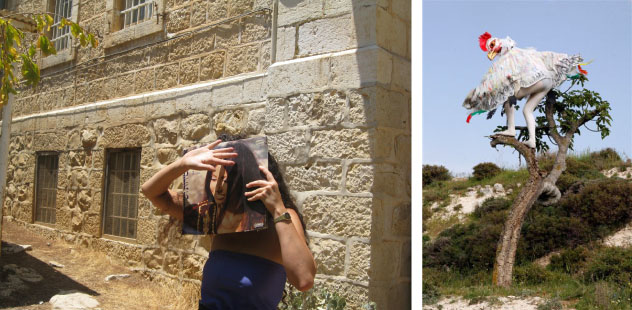
Herzl and Me, Dir. Guy Biran / And The Storm Dissipated, Dir. Adam Yachin
In March this year we launched Bamakom project at Hazira. "And The Storm Dissipated" – a hallucinatory musical performance about a nameless soldier conquering a nameless hill, directed by Adam Yachin, who eagerly jumped the offer to work outside of the theatre, inspired by a place. It was a kind of ‘journey theatre’. It took place on a hill that used to be a Jordanian, near Mar Elias Monastery, overlooking Har Choma neighborhood and the neighboring Arab villages. The audience followed the plot – from an ancient olive grove all the way to the top of the hill. The performance was very impressive – giant masks, large cast, including actors, musicians, all-girl dancing troupe and a herd of local sheep.
I really do hope in the years I will be able to continue with Bamakom project. I won’t exaggerate if I said that this is one the most important things to me in Hazira: perhaps because I experience Jerusalem as an arena, encompassing topic, content, imagery and set for what could be a theatrical spectacle. And perhaps because site-specific work offers a different way of thinking about performance – the performances and performers are invited to confront, live, the place where they are created. A theatre maker arriving at a place that’s not a theatre is required to broaden and open out their artistic perception, so that a new and authentic thing can be created. And if that’s not the thing we crave the most in theatre, I have no idea why we spend the better half of our time there.
From Hebrow: Sivan Gabrielovich - Gal
Guy Biran studied theatre direction at "Seminar Hakibutzim" and took part in many master classes in Israel and abroad. Since 1992 he directs and teaches in different institutions in Isreal, Holland, Germany, India and the U.S. In the last 13 years he was tutoring the director's project at The Theaterschool, Amsterdam. Today he is the Artistic Director of Hazira