


The Medium is…


- Details
Ran Brown
The Medium is…
Interview with Matt Adams
It seems as though it’d be hard to find anyone today who isn’t familiar with Marshall Mcluhan famous quote “the medium is the message”. Mcluhan’s book Understanding Media: The Extensions of Man (1964) was written years before the PC revolution (yes, there was such a revolution!), and prior to the rise of the Internet. Mcluhan’s diagnoses, which at the time seemed paranoid and utterly unrealistic, were found to be incredibly precise, and they can still stimulate new thinking about the nature of society at large.
It’s interesting in relation to dance in general, and video dance in particular, that Mcluhan visualized the media based technologies as extensions of human beings. The wheel, the light bulb, TV and radio are all machines which extend the body: a light bulb extends a person’s eyesight range, the wheel is the extension of the legs, the radio is an extension of the ear, and so on and so forth. He emphasized the fact that it’s not the content of media technologies that’s essential, but the medium itself – the machine in which the content is stored and via which it is distributed. The medium itself is the message, since the medium is “what determines the scale and means of human communications and actions“ (Facebook anyone?).
Mcluhan thought that it’s actually the media technologies that demand a person’s involvement with the rest of humanity. He believed it’s the electronic crowdedness that obligates people to partake and commit, and that it’s due to the electronic crowdedness that the world is nothing but a village (yes, it was him who coined the term ‘global village’). What Mcluhan didn’t take into consideration is that the same crowdedness can lead to apathy and passivity. When he coined the phrase ‘the medium is the message’ he meant that each medium, meaning each extension of our bears ramifications on man and society at large. In his mind, technology can do much more that join what we already are anyway. In this context it’d be interesting to ask what can video dance do that doesn’t already exist in video and in dance anyway?
Mcluhan believed in the power of artists to carry out this investigation; a questioning artist, he believed, is the only person who can enter a conflict with technology yet stay immune to it, since he is familiar with changes in his sensorial perception and is aware of them. Mcluhan even addressed the use of dance in the cinematic medium when he wrote about Charlie Chaplin, who paved a new way when he "hit upon the wondrous media mix of ballet and film in developing his Pavlova-like alternation of ecstasy and waddle. He adopted the classical steps of ballet to a movie mime that converged exactly the right blend of the lyrical and the ironic (Mcluhan, 1964, 67). According to Mcluhan, “Artists in various fields are always the first to discover how to enable one medium to use or to release the power of another” (Ibid.).
A group of artists who that’s engaged in this particular field of enquiry is Blast Theory. Blast Theory are a world renowned group dealing with interactive media, creating new forms of interactive live art which involves online audiences, online live performance, and digital broadcast. The group, founded in 1991, includes three core members, Matt Adams, Ju Row Farr and Nick Tandavanitj, who examine technology’s social and political aspects. Their work deals with a heavily saturated communications world, controlled by popular culture, via performance, installation, video and mobile devices’ technologies, in order to ask questions in regards to the ideologies present in the information we consume.
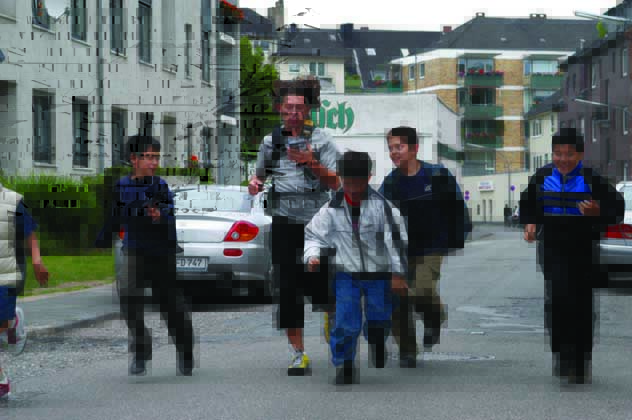
"Can You See Me Now?" by Blast Theory
Matt Adams, one of the group founding members, was a guest of honor at the Video/Dance Festival held at the School of Visual Theatre held in Jerusalem last May, and kindly agreed to share with Maakaf readers some of his observations on video dance.
In the light of the vast range of Blast Theory's work and their character, I was wondering how do you feel about being invited to a video dance festival, under this category.
First of all I was curious to come and see the festival and to see how it was. We always had a very strong links to dance and choreography practice. There are three artists in Blast theory and one of us, Ju Row Farr is trained as a dancer for about 15 years. She had to stop dancing because she had a back injury. She always bring this point of view into our work. And we also two of our associate artists are dancers: Shieal Galani is a performance maker and Becky Edmonds is also a video-dance artist.
Early work that we made had strong physical choreographic elements to them, a kind of a mix sort of "vim vendkybos" to people who cannot dance. We also have an input from the American company called Go Island who also works strongly with choreography language. In that sense there is a kind of thread of choreographic interest in terms of the work that we make.
I am also a big believer that the boundaries between modern dance as it commonly understood and other forms of choreographic practices is very fluid. You can get choreographic interests, satisfaction and pleasure in all sorts of places. Farkor for example is entirely choreographic process and engaging with the city and yet it has nothing insensibly to do with dance. People are planning little routines and pulling off little gestures, as a tremendous pleasure of the body and how it is being used. Though it is a different kind context that is not dance doesn't make it less interesting for me. I'm always excited to be in a situation where we can open up a discussion about where the body and movement might actually exist outside of stereotypical vision of what contemporary dance might look like.
How do you see the connection between dance and video?
Perhaps I'm not the best person to talk about it because my honest view is a kind of dated concept. A lot of the video dance is about filming dance and editing that change it, or a use of particular location that we couldn't do before. However I think that if you look at what technology has done in the last 15-20 years is a lot more profound then the ability to film dance or use film as choreographic form.The most interesting video dance work is something that goes beyond film and dancers its really thinking completely differently about where choreography takes place, what the essence of choreography practice is
For me it's an awkward marriage. Some fantastic work has come out of it but I am not sure about the idea that it is a genre.
I can see why dancers would like to use video; it's partly documentation and it's partly about new possibilities for how you can instruct dance. But "who the audience is?" is more difficult question. Who is the audience of this work outside of festivals? In the UK there was a time when these shows were shown on TV. My first ever experience of Pina Baush was channel flicking on TV at 23:00 and I came across of a piece of her. But unfortunately those days are all over. TV hardly shows dance.
It is hard to find Dance on TV, but on the other hand there is Facebook and Youtube, and on this sense people's practice is more accessible.
True, for me the fundamental cultural observation of the last 15 years will be of the shift towards participatory culture. The late twentieth century was about a mass media culture of film, television, radio, magazines and record cd's being broadcast outwards towards a mass audience who then consumed it in various different ways. That model has broken and it's only in the last 20 years that it has gone from being quite a coherent model of how culture was distributed in a capitalist mode to the current state where thousands of minutes are uploaded to youtube every hour and exponentially increasing.
I don't see things as trivial. Though most of the videos in youtube are trivial I think that the model is not: It's a channel for people to present and to engage with an audience and with each other. It has a tremendous potential. I think it is just a step in stone a long the way.
How does all of this affect performing arts?
Not that long ago I could go to theatre conferences and find people still talking with a strait face about the superiority of liveness compare to electronic media. It is mentioned as if it is given that the natural state of things is that live performance is superior to film or television.
And you don't agree…
No, I don't. And I think that it is a false dichotomy. The idea that you can talk about superiority in those ways, seems to me a bizarre theological debate. I find it Bizarre to question the idea that people couldn't get rich cultural experiences in many different forms.
What live things have is this incredible ability for the negotiation between the creator or the performer and the audience in real time. But the setting we have now in the conventional theatre (sits in front of a stage) doesn't allow utilizing the potential.
Theatre people have tendency to assume that when you are performing you can sense the audience and the audience is different each night. This assumption minimizes the exchange between the audience and the performers. There is an exchange but fairly modest one, it doesn't go very far. The exchange can be rich but its quite an internalized one: the actors are internally aware of what is s going on and responding to it and the audiences are internally aware of it and respond, but all is internal. There are ways where in which this kind of "live electricity" can be shared differently and some of the work that we have been making is to try and think about how this relationship can be reconfigured to create new possibilities.
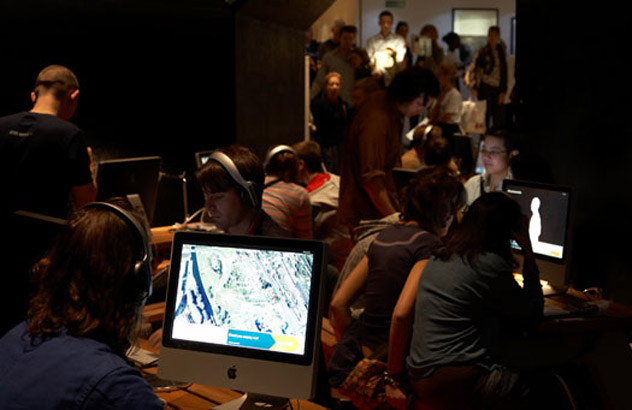
"You Get Me" by Blast Theory. Photographer: Ben McConnel
I think it's not a question of superiority: Live performance and technology. I am not a cheer leader for technology, but I do believe that this is a very fundamental change. When something grows from 4 people to four hundred million in 5 years… it is a place where people are talking and sharing together. It seems strange to me that as makers of live work we wouldn't be interested and ready to engage with that and think about that.
It may well be that our role as live makers is to critique the social structure of the online media, But if a year ago I could meet people quite often who would not like to join facebook today it is impossible. A lot of the work that we make in Blast theory is trying to ask questions about that: is this a community ? Can you trust people there? Can you have a meaning full connections in electronic spaces ? What kinds of conversations and relationships are possible to have online?
So what is interesting for you in video dance…?
I'm always curious when there is something at stake for the creator. It makes a tremendous difference to the kind of energy to the piece of work if the person who makes it is taking a risk or is in a territory of uncertainty. And secondly I do think it's about thinking carefully about why you are doing this. I don't think it is a stupid question. I do think you need to try and answer that. It’s a question you can never answer fully. Part of the creative process is that it's not all known and you can't explain in your mouth what are you doing or what it is, other wise you would do that instead of doing work.
I would say some of the riches aspect of the work that we make, its things that I don't normally talk about because they are very personal. It's difficult for me to articulate but I know that they are constant threads in the work that we are making. Its not about a coherent answer but its about asking that question really sincerely and honestly.
I am always interested in work that thinks carefully about the audience: who the audience is, why they are coming there, where they have come to? What is the reason? What the possible reasons are for this particular moment in time.
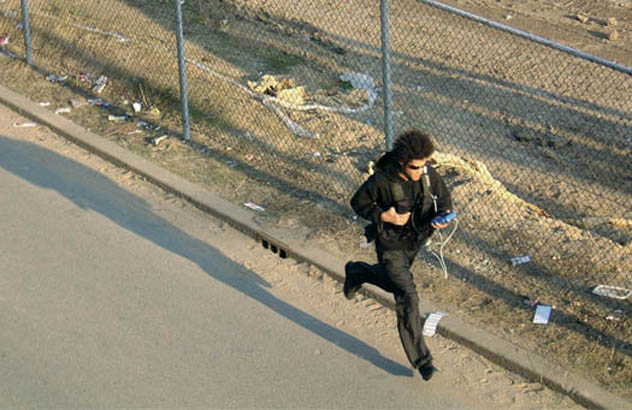
"Can You See Me Now?" by Blast Theory
Thinking carefully and consistently about who the public is, is actually important and understated in most performance arts school and art school (and arts in general). The traditional idea is that the best artists don't bother about the public and they just make it and so on. But I think if you are doing live work this is a very strange work to do. You are putting it on in a very particular place, its not random. If for example you show a piece of work in May 2010 in Jerusalem you have a particular context that is critical. And most people are doing that anyway subconsciously. You know what the limits are of acceptability in any different society. If a character on stage says something rude about a Muslim you would be very conscious of where he was before you put the production on. That is an extreme example but it's indicative of the level of thinking about who the audience is and why they are there.
This questions are adequate to all kind of performances. Do you think there are particular aspects to Video-dance work?
To be honest, I have a very clear answer that I have once written. Its based on 7 ways withi which you can use video in live a performance:
1. Quotation: to quote a source eg. a clip of a Hollywood film
2. Textural: as an additional layer/atmosphere e.g. abstract visuals
3. Documentary: to bring evidence into the performance eg. vox pop interviews
4. Testimony: to show personal elements eg. interviews, monologues with performers, talking direct to camera
5. Performance: performers talk/move eg. a monologue (can interact directly with live performers)
6. Reframing: use a live camera to transmit footage of a performance event in one part of the performance space to a monitor/video projector in another area.
7. Time Shifting: to video a performance event for playback later in the show.
Of course that today the ability to make things is vast: thanks to the digital tools that exist today you can film, edit and add affects in five minutes with you pc… the formal option to use video are powerful. Worth thinking.
English translation by Sivan Gabrielovich - Gal (introduction) and Hedva Eltanani (interview).